
The cheer pom pom — originally spelled pom pon — was invented by Lawrence R. "Herkie" Herkimer, who filed for a patent on 17 September 1968 and was granted US patent 3,560,313 on 2 February 1971. The patent is titled simply "Pom Pon." Its central idea is the hidden handle: a U-shaped strap over a small rectangular body that the hand slides into, so the pom appears to sit on the fist with no stick showing. Herkimer deliberately spelled it "pom pon" because "pompom" carried vulgar meanings in other languages. Nearly every cheer and dance pom made since — including lit ones — is a descendant of that construction.
The patent itself

Sheet one of the filing shows the whole idea in five drawings. Figure 1 is the part that matters: a rectangular body with a U-shaped handle of soft flexible material arched over its top face, sized so a hand slides between the handle and the body. Figures 2 and 3 show the finished pom — a dense ball of strands with no visible grip anywhere.
The strand construction is specified just as carefully. Sheets of crepe paper are partially cut at even intervals, so the strands stay joined along a continuous edge band. That band is wrapped around the body several times and stapled. Cut this way, the strands splay out from every side and the pom reads as a ball rather than a brush.
Then the detail that tells you he had actually watched cheerleaders use these: a polyvinyl chloride sheath wrapped tightly around the paper band. Its stated job is to protect the join and the user's hands from moisture and dye transfer, and to stop strands shedding during vigorous use. Before that, crepe paper poms bled dye onto wet hands and moulted through a game.
Why "pom pon" and not "pom pom"
This is the part people still argue about in comment sections. Herkimer chose the "pon" spelling on purpose, after learning that "pompom" carried vulgar connotations in other languages. The patent title is "Pom Pon," and for decades the equipment, the camps and the competition divisions used that spelling.
"Pom pom" won anyway through ordinary usage. Both are correct now, but if you have ever seen a programme called a pom pon squad and assumed it was a typo — it is actually the older, original spelling, and the one on the patent.
A correction worth making
A lot of tributes and encyclopedia entries describe patent 3,560,313 as covering a "flameproof Mylar version with a hidden handle." The hidden handle part is right. The material part is not: the patent document specifies crepe paper strands with a PVC sheath, not Mylar. Metallic mylar poms came later as a product, not as what was claimed in 1971.
It is a small thing, but it gets repeated a lot, and the original filing is public and easy to read.
The man behind it
Lawrence Russell Herkimer (14 October 1925 – 1 July 2015) cheered at Southern Methodist University, where he invented the Herkie jump — one arm up, one hand on the hip, one leg straight out and the other bent back — by accident, while attempting a split jump and not quite getting there.
In 1948 he ran his first cheerleading camp at Sam Houston State Teachers College in Huntsville, Texas. Fifty-two girls and one boy attended. The next year, 350 came. He incorporated the National Cheerleaders Association in 1961.
The spirit stick is his too. At a 1954 camp he was struck by a squad with no technical skill and a relentlessly good attitude, so he cut a branch off a tree, painted it, and gave it to them. Schools have been handing that trophy down ever since.
The pom pon itself came out of a practical observation: colour television. Cheerleaders were suddenly getting real camera time, and what read well on colour broadcast was something big, bright and moving in the hands.
What changed, and what did not

Fifty-odd years on, the thing Herkimer got right is still the thing nobody has replaced. The hand still goes inside the pom. Modern baton handles are moulded rather than stapled crepe paper, but the principle has not moved: the grip disappears, so the audience sees a ball of colour and not a stick.
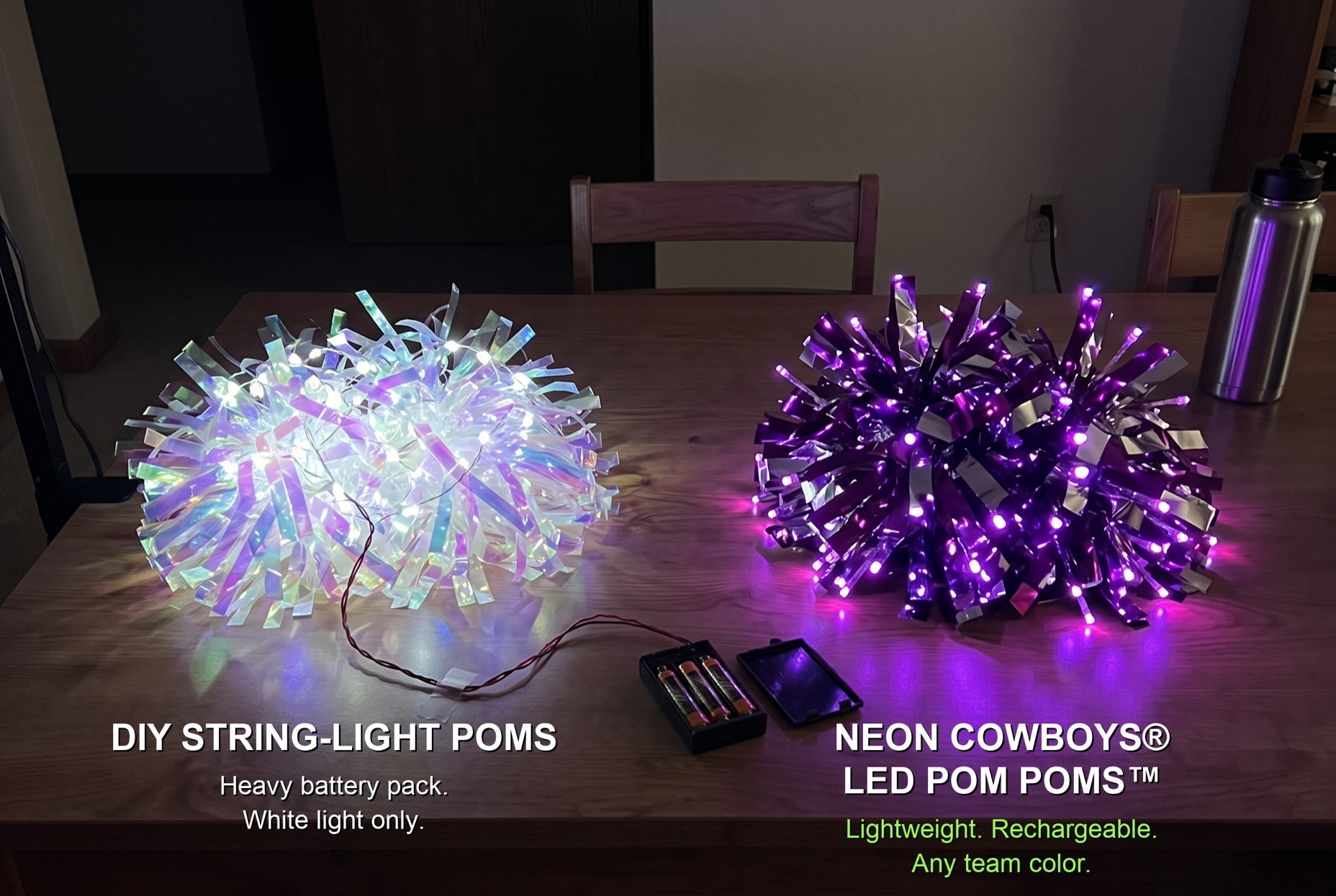
What has changed is the material and, lately, the power. Crepe paper gave way to metallic mylar, which reflects stadium light instead of absorbing it. The next step is the one Herkimer's original problem statement points straight at — he was solving for visibility on camera, and the limit on a reflective pom is that it has no light of its own. Put diodes through the streamers and that limit goes away: the pom is visible when the stadium goes dark, in whatever colour the team picks.
Same hidden handle. Different century.

Made by Neon Cowboys®
Light-Up LED Pom Poms
- Premium double-ended baton handle — buried in the pom, as it has been since 1971
- Diodes built through the pom itself, not a single light in the handle
- 6-inch performance size, remote colour-changing across the whole squad
- Made to order in your team colours
Sources
- US Patent 3,560,313, "Pom Pon," L. R. Herkimer, filed 17 September 1968, granted 2 February 1971 — full text and drawings
- Southern Methodist University, "Cheerleading pioneer and SMU alumnus Lawrence Herkimer dies," 3 July 2015
See also: the complete cheer & dance pom buying guide, how LED pom poms work and iridescent vs LED poms.
Questions: info@neoncowboys.com.