
Hockey does have cheer and dance performers, but the format is different from football or basketball. Most are called ice crews or ice teams rather than cheerleaders, they perform on skates during intermissions and television timeouts rather than on a sideline, and a growing number of professional clubs have moved to co-ed promo teams or dropped the role entirely. Where performance teams do exist, the arena environment is the opposite of a football field: dark, enclosed, and built around a spotlit sheet of reflective ice.

What an ice crew actually does
The role is a blend of performance and game operations, and the mix leans more towards operations than most people expect:
- Ice maintenance during stoppages — shovelling snow off the surface at television timeouts, which is the original reason the role exists.
- Intermission performances — the closest thing to a traditional routine, performed on skates.
- Crowd and sponsor activations — t-shirt tosses, in-game promotions, fan engagement in the concourse.
Skating ability is usually the first requirement. Dance ability is second.
The honest state of the category
Worth knowing if you are researching this: professional hockey performance teams have been shrinking for about a decade. Several clubs disbanded their teams outright, and others restructured into co-ed promotional crews with more emphasis on fan relations and less on performance, following sustained criticism of pay and working conditions.
The role is most alive today at minor league and junior clubs, where ice crews remain common, and at the collegiate level, where some programmes send their cheer or dance squad to hockey games as part of a broader athletics commitment. That last group is who most of this article is for.
Cheering a hockey game is its own problem
If your squad covers hockey as part of a college athletics rotation, almost nothing transfers from football:
- Play barely stops. Hockey runs in long continuous shifts. There is no equivalent of a football down or a basketball timeout every two minutes.
- You are usually not rink-side. Glass, boards and player benches mean performers are often in a corner, on a platform, or in the stands rather than at ice level.
- The crowd has its own rhythms. Hockey crowds are led by the organ, the goal horn and long-established chants. A squad is joining something, not starting it.
- Intermissions are the performance window. Two of them, around fifteen minutes each. That is where a routine goes.
The lighting is the interesting part
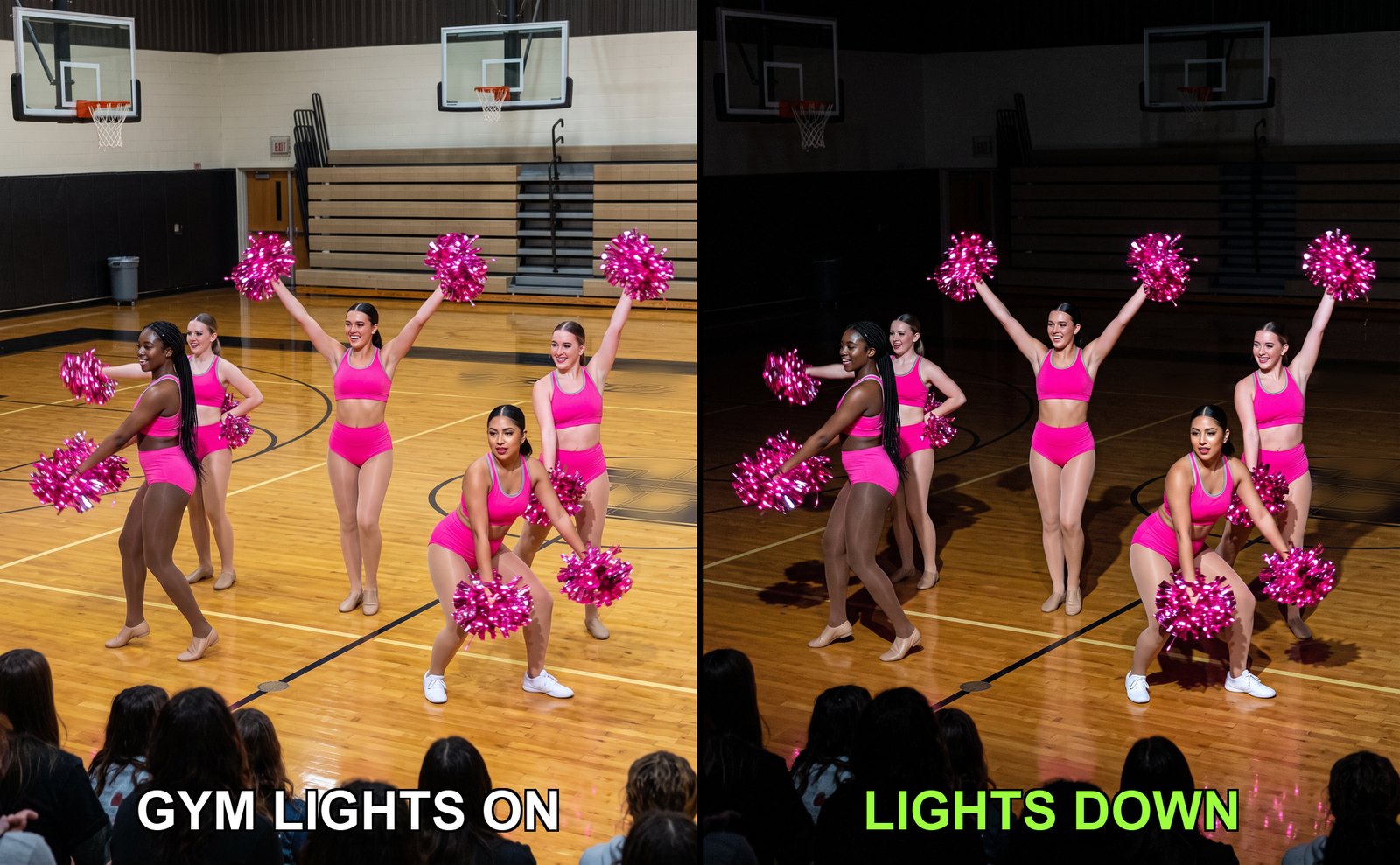
Hockey arenas are the darkest regular venue in team sport. The seating bowl is kept dim and the light is concentrated on the ice, which is a large white reflective surface. Most clubs also run a full blackout with spotlights for starting lineups, and many do it again before the third period.
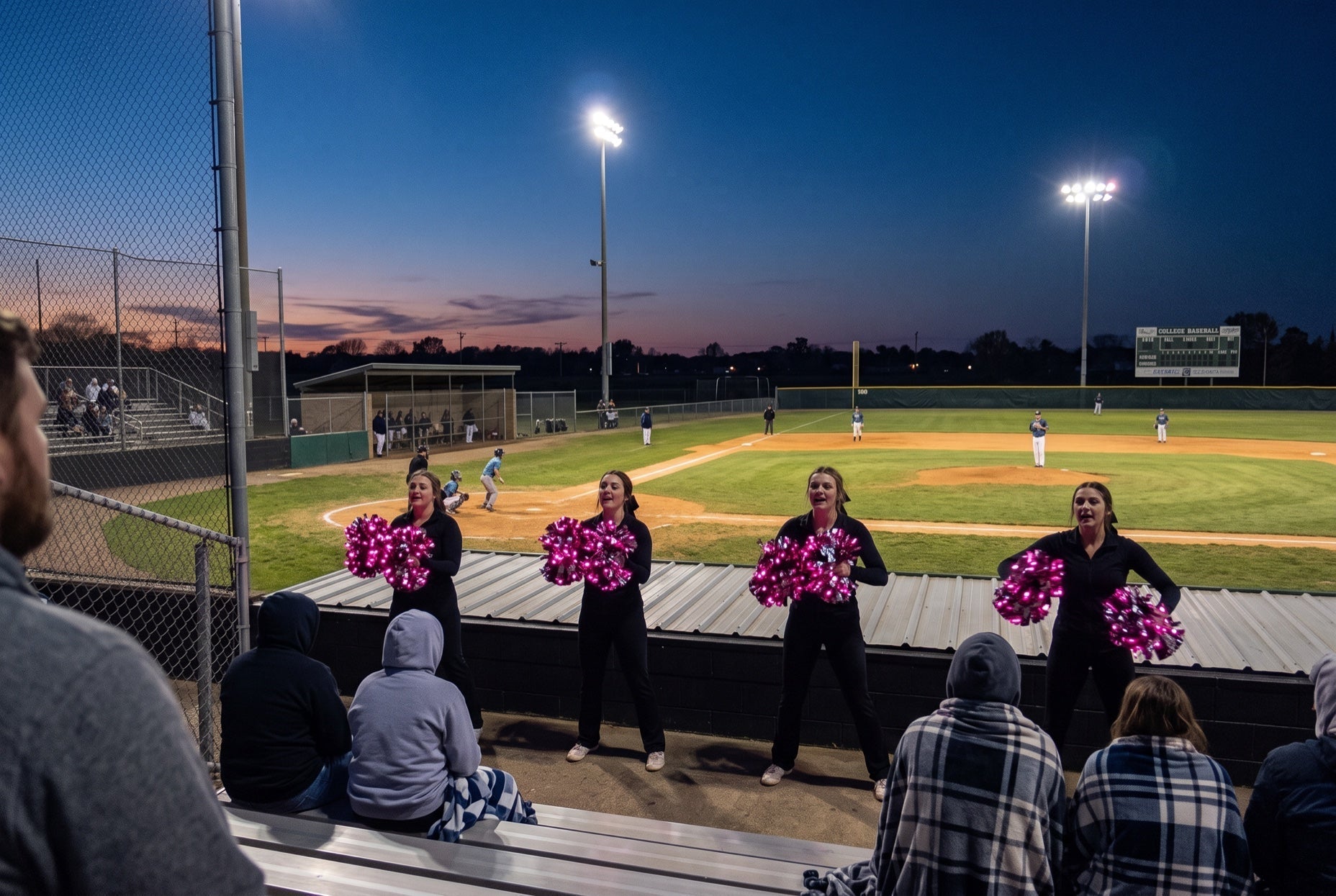
For anyone performing there, that is the opposite problem to a football field. Outdoors under floodlights, everything is evenly and brightly lit and reflective materials look excellent. In a dark arena bowl, reflective materials have very little to reflect — and the performers are frequently positioned away from the lit ice, in the dimmest part of the building.
Equipment that produces its own light solves a real problem in that environment rather than a decorative one. It is also the only kind that survives a full blackout intro, which in hockey is a near-universal part of the run of show.

Made by Neon Cowboys®
Light-Up LED Pom Poms
- Visible in a dark arena bowl, including through a blackout introduction
- Remote colour-changing across the whole team
- Rechargeable, with the pack built into the handle — nothing trailing
- Made to order in your team colours
See also: basketball cheer and the winter season and why poms look different outdoors and indoors.
Questions: info@neoncowboys.com.