
Cheer and dance competition season runs from roughly December through early May, with the national championships clustered in January, February and March and the biggest end-of-season events in late April. Because routines are judged on synchronisation and overall visual impression as well as skills, equipment decisions matter more here than at any game. Anything made to order needs four to six weeks, so a squad competing in January is ordering in November.
The season at a glance
Dates move year to year, but the shape does not:
| Window | What happens |
|---|---|
| Sept–Nov | Routines choreographed, music cut, squads set. Equipment ordered. |
| Dec | Early local and regional competitions. First time the routine is seen. |
| Mid-Jan | College national championships. |
| Late Jan–early Feb | High school national championships. |
| March | All-star national championships. |
| Late April–early May | The end-of-season world and summit-level events. |
Note what that means for the calendar as a whole: football cheer ends in November, and the most demanding part of the year starts immediately afterwards.
What judges are actually scoring
Skills and execution dominate, but every major scoresheet carries some version of overall impression, showmanship or visual effect — and synchronisation runs through the whole sheet. That is where equipment stops being decoration and starts being points.
- Synchronisation is visible in the props. Twelve poms moving as one reads as clean. Twelve poms that are slightly different ages, densities and brightnesses read as sloppy even when the motions are identical.
- Uniformity across the squad. Mismatched equipment is one of the few deductions a team can fix by writing a cheque instead of by training.
- Visual impact has to survive the room. Competition floors are usually lit flat and bright. Some venues go dark for an entrance. Know which you are walking into.
Lighting: check the venue before you plan the effect

This is the detail that catches teams out. Most competition floors are in convention centres under flat, even, very bright lighting, because the judges and the cameras need to see the skills. Under that light, a lit pom reads as a coloured pom — still good, but the glow is not the story.
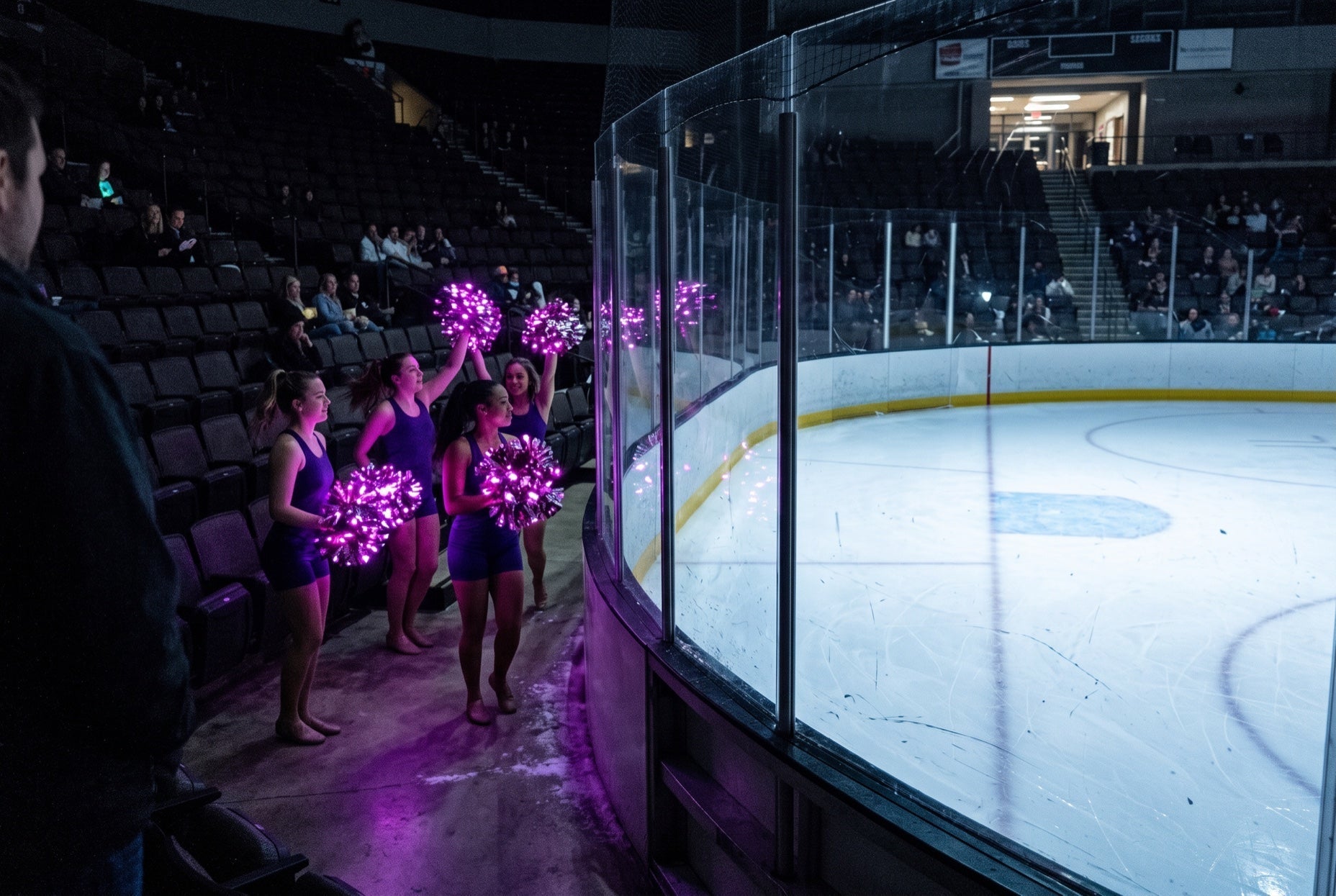
A growing number of events run a darkened entrance or a lights-down moment for the arena-level finals, and that is where emitted light does something nothing else can.
So: ask the event what the lighting is before you build a routine around an effect. If the floor is bright, pick equipment on colour match and uniformity. If there is a dark moment, that is where to put the thing everyone will film.
Working backwards from your first competition
The timeline that actually matters:
- Order the equipment. Everything made to order has a production window, and it is production time rather than shipping. Email us with your date and we will tell you plainly whether it works.
- Add two weeks to rehearse with it. New equipment changes timing — weight and length both affect how a motion lands. Nobody should be competing with something they first held that week.
- Add buffer for the unexpected. Sizing, a colour that is not right, a damaged item.
So the order goes in well before the routine does. If you are competing in January, you are deciding in autumn, not in December.
If you are reading this in autumn and competing in January, you are at the start of that window, not the end of it.

Made by Neon Cowboys®
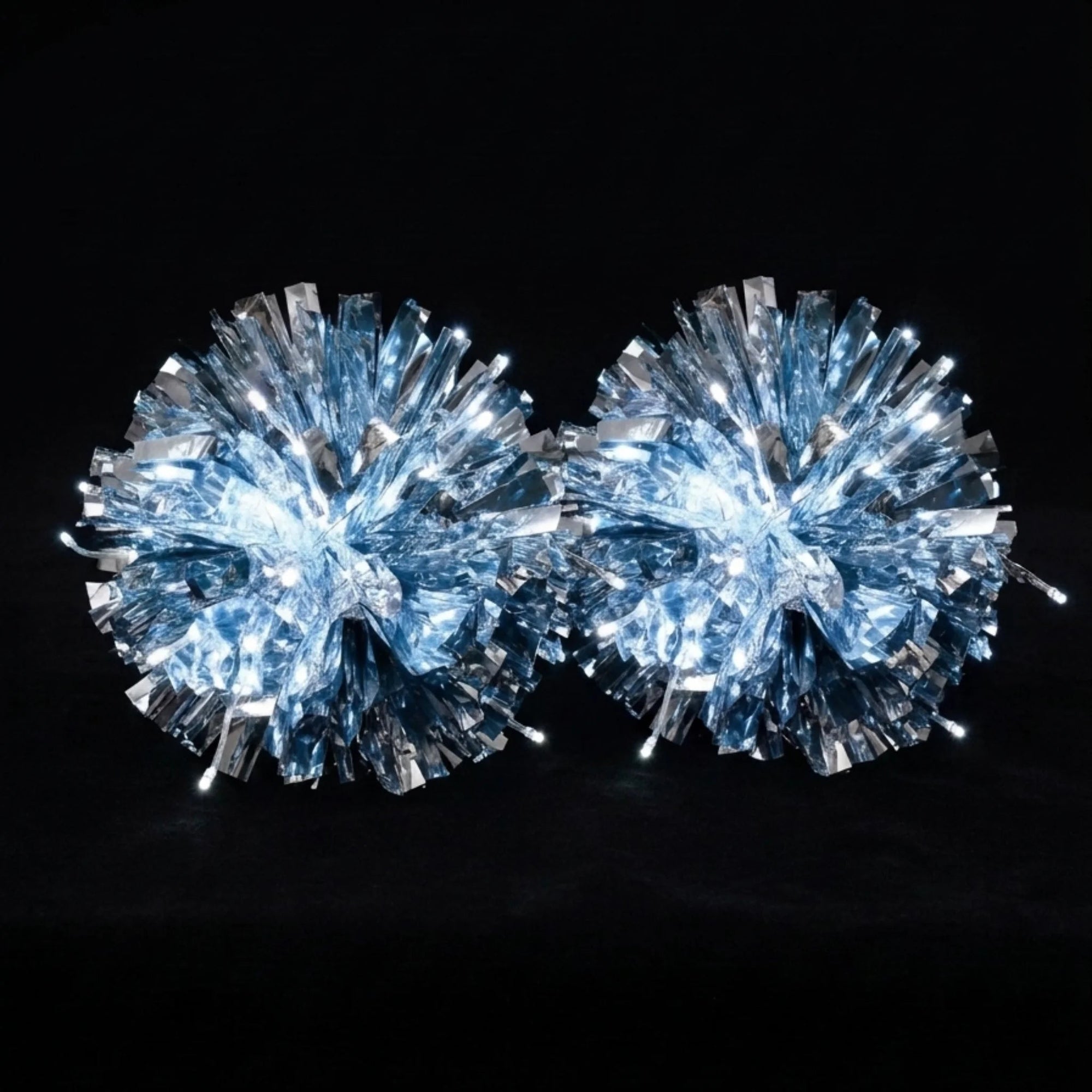
Light-Up LED Pom Poms
- Matched across the whole squad — made together, in one colour spec
- Remote colour-changing, so one set covers every routine and theme
- 6-inch performance size on a premium double-ended baton handle
- Made to order — email us with your competition date and we will tell you if it is possible
Not sure you will make the window? Email us with your competition date and we will tell you honestly whether it is possible.
See also: basketball cheer and the winter season, dance poms and the competitive Pom division and bulk and wholesale team orders.
Questions: info@neoncowboys.com.