
Football players wear eye black to cut glare from the sun and stadium lights, so a ball coming out of a bright sky is easier to track. The evidence that it works is real but modest: a 2003 Yale study by Brian DeBroff and Patricia Pahk tested 46 people and found that black eye grease improved contrast sensitivity by roughly one level on a Pelli-Robson chart, while commercial anti-glare stickers and a petroleum jelly placebo did not. The improvement was statistically significant and practically small. A good deal of why it is still worn is tradition, intimidation and looking the part.
The glare theory
The skin on the cheekbone is slightly shiny and sits directly below the eye. In bright conditions it bounces light back up into the lower field of vision, which reduces contrast — the thing you need to pick a ball out against a bright sky. Matte black grease absorbs that light instead of reflecting it.
That is the mechanism, and it is sound in principle. The argument has always been about how much difference it actually makes to someone whose vision is already excellent.
What the research actually found
The study people cite is DeBroff and Pahk's 2003 work at Yale. Forty-six participants aged 18 to 30 were tested for contrast sensitivity without any product, then randomised to black eye grease, commercial anti-glare stickers, or petroleum jelly as a placebo, and tested again in sunlight.
The findings:
- Eye black grease improved contrast sensitivity by about one level on the Pelli-Robson chart.
- Anti-glare stickers did not. Neither did the petroleum jelly.
The honest caveats matter too. Participants could see which product they had been given, which introduces demand bias. There was no bare-skin control condition, and the petroleum jelly may itself have added glare that normal skin would not. And "one level of contrast sensitivity" is a genuine but small effect — it is not the difference between catching and dropping.
So: grease does something measurable. Stickers sold as anti-glare did not perform in that test. If glare control is what you want, buy the grease.
The part nobody measures
Ask players and you will mostly hear reasons that have nothing to do with optics. It is a ritual that marks the shift from warmups to the game. It looks intimidating. It is what the players they grew up watching wore. Those are real reasons for a real behaviour, and they explain why eye black is worn indoors, at night, and in weather where glare is not remotely a factor.
Grease, strips and tape — what the difference is
- Grease. A wax or lanolin-based black stick applied by hand. Matte, cheap, effective, and migrates when you sweat.
- Strips and stickers. Adhesive patches that go on clean and come off clean. Much tidier, and the format most teams prefer for photos — but as above, the anti-glare performance did not hold up in testing.
- Tape. Usually matte athletic tape cut to shape. Sits somewhere between the two.
Worth knowing if you are planning anything personalised: college football rules require eye shade to be solid black with no words, numbers, logos or other symbols, in force since the 2010 season. Many high school associations have similar restrictions, so check with your athletic director.
At night, the whole problem inverts

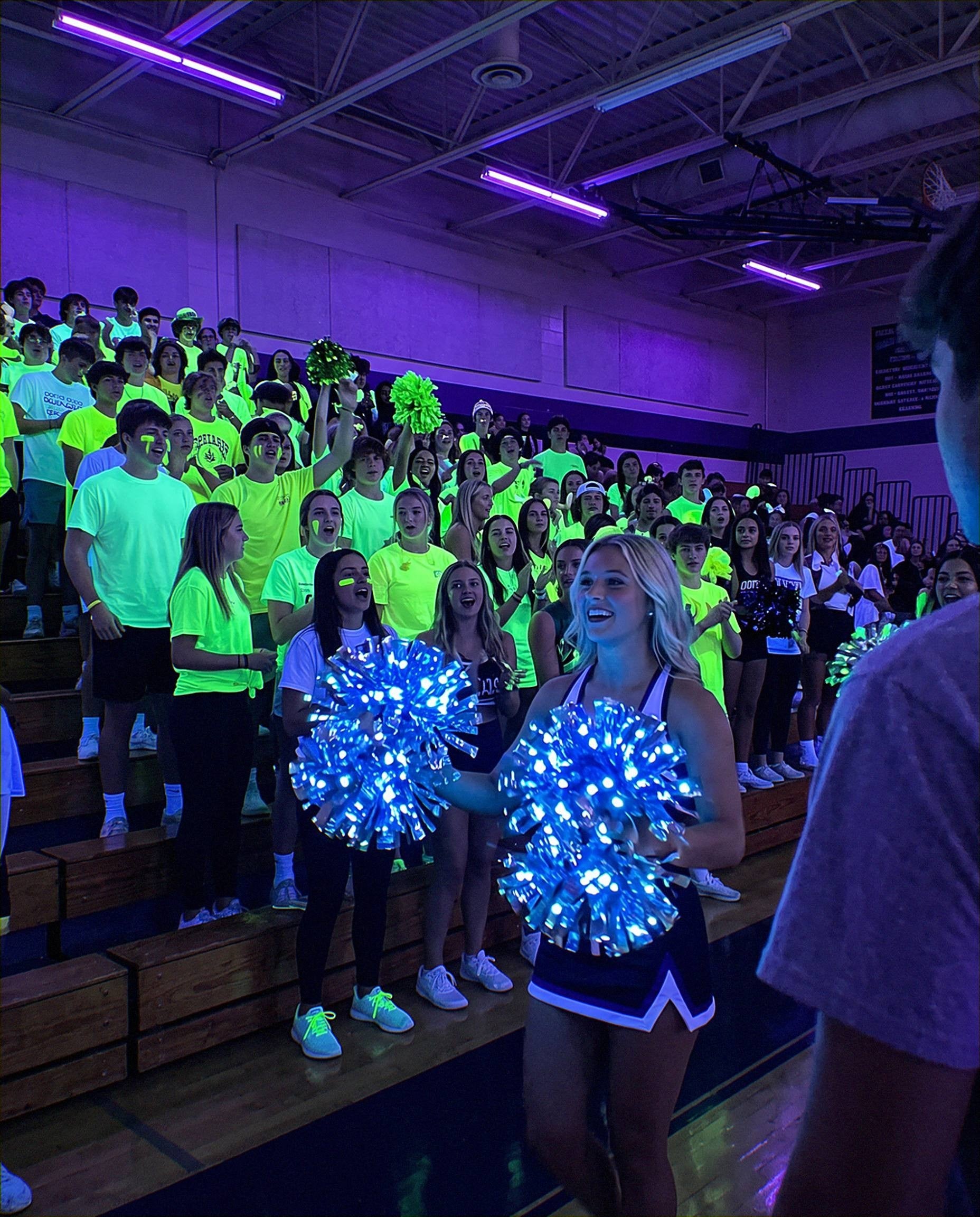
Everything above is about daylight. Under floodlights the sun is not the problem, and eye black is mostly ritual at that point. For anyone whose job at a night game is to be seen rather than to see — cheer squads, dance teams, the student section — a black mark on the face is the worst possible choice. It absorbs what little light there is and vanishes at any distance.
That is a different product category, and it is the one we make: lit shapes on the cheekbone that read from the far side of a stadium after dark. We do not make eye black, and we would not pretend our stickers help you track a ball. They help people see you.

Made by Neon Cowboys®
LED Light-Up Face Stickers
- For being seen after dark, not for glare control
- Shapes that read from the stands — stars, hearts, lightning
- Reusable and skin-safe, in colours you pick
- Custom shapes for teams and programmes in bulk runs
Sources
- DeBroff BM, Pahk PJ, "The ability of periorbitally applied antiglare products to improve contrast sensitivity in conditions of sunlight exposure," 2003.
- NCAA Playing Rules Oversight Panel, eye shade clarification approved 14 April 2010, effective for the 2010 season.
See also: eye black designs and ideas and game day face paint vs LED face stickers.
Questions: info@neoncowboys.com.